.jpg)
After a string of extremely low and even negative monthly numbers, the industrial sector grew by 2.6 per cent year on year, far exceeding expectations.

The output of eight core infrastructure sectors contracted for the third month in a row by 1.3 per cent in December 2020, dragged down by poor show by crude oil, natural gas, refinery products, fertiliser, steel and cement sectors. The core sectors had expanded by 3.1 per cent in December 2019, according to the provisional data released by the Commerce and Industry Ministry on Friday. Barring coal and electricity, all sectors recorded negative growth in December 2020. During April-December 2020-21, the sectors' output declined by 10.1 per cent against a growth rate of 0.6 per cent in the same period of the previous year.

India's Index of Industrial Production -- which measures industrial growth -- plunged to a dismal 1.6 per cent in December 2010 from 18 per cent in the same period a year ago due to the poor performance of the manufacturing sector.

The output of eight core sectors grew by 16.8 per cent in May, mainly due to a low base effect and uptick in production of natural gas, refinery products, steel, cement and electricity, official data released on Wednesday showed. The eight infrastructure sectors of coal, crude oil, natural gas, refinery products, fertilisers, steel, cement and electricity had contracted by 21.4 per cent in May 2020 due to the lockdown restrictions imposed to control the spread of the COVID-19 infections. In March this year, these key sectors had recorded a growth of 11.4 per cent, and 60.9 per cent in April.

The output of eight core sectors grew 8.9 per cent in June, mainly due to a low base effect and uptick in production of natural gas, steel, coal and electricity, official data showed on Friday. The eight infrastructure sectors of coal, crude oil, natural gas, refinery products, fertilisers, steel, cement and electricity had contracted by 12.4 per cent in June 2020 due to the lockdown restrictions imposed to control the spread of coronavirus infections. In May this year, these key sectors had recorded a growth of 16.3 per cent, while it was 60.9 per cent in April.

Most of the economic activity in the country had come to a standstill after the government imposed a 21-day nationwide lockdown beginning March 25 to check the spread of coronavirus.

Within IIP, the capital goods sub-index has contracted for seven continuous months, suggesting investment demand continues to be weak.

FPIs sold shares worth a net Rs 1236.95 crore on Friday.

They feel reducing policy rates will help to boost production and revive the economy.

The broader NSE Nifty closed 1.25 points, or 0.01 per cent down at 10,564.05.
Pulled down by the mining and electricity sectors, the Index of Industrial Production stood at 8.8 per cent during April 2005 compared to 8.9 per cent in the same month last year.
.jpg)
The marginal improvement in the index of industrial production was mainly on account of higher power generation and mining sector output, while manufacturing declined.

The index of industrial production, which was negative in March, was positive in April - but just barely.

The NSE Nifty settled at 4,680, up 21 points. The market breadth was positive -- out of 2,867 stocks, 1,941 advanced and 853 declined on Wednesday.
Short-circuited by the lacklusture performance of electricity sector, the industry recorded a marginal slowdown in growth at 6.2 per cent in May this year compared to 6.4 per cent recorded in the comparable month of 2003.

'It is far too early to celebrate the numbers.' 'They are still fairly weak compared to the pre-pandemic level.'

Industrial output rose to nearly three-year high of 6.4% in August.

The previous low at 1.8 per cent was recorded in October 2017.

The mismatch between PMI and core sector could also be due to the fact that while core sector is calculated year-on-year, PMI is calculated month-on-month.

India's industrial output rose by 10.3 per cent in October against 0.1 per cent in the same month last year.
Industrial production is expected to dip marginally in the next 3 months due to rupee gaining strength against the dollar and declining non-food credit, even as petrol and diesel might become cheaper, the Institute of Economic Growth said.


RBI unsure whether to cut rates or not in its next monetary policy.

Analysts polled by Reuters had expected an annual output growth of 3.5 per cent for the month.
Industrial growth slowed to 3.6 per cent in February, 2011, compared to 15.1 per cent expansion in the year-ago period, dragged down by poor performance of manufacturing and mining sectors.
Led by strong recovery in the manufacturing sector, industry grew at 7.9 per cent in the first six months of the current fiscal compared to 6.2 per cent in the same period last year.
Propelled by a strong growth in manufacturing, the industrial production grew by 6.4 per cent in January over the same period of the previous year.

The 30-share Sensex is down 359 points at 26,378 and the Nifty has dropped 78 points to trade at 7,883

India's factory output climbed 22.4 per cent in March, benefiting from the base effect of the lockdown-marred month a year back as well as a turnaround in the manufacturing sector, while retail inflation slipped to a three-month low of 4.29 per cent in April. The high positive annual growth in the index of industrial production (IIP) in March 2021 came on back of a contraction of (-)0.9 per cent and (-)3.4 per cent in January and February 2021 respectively, according to the data released by the National Statistical Office (NSO) on Wednesday. This turnaround was led by recovery in the mining, manufacturing and electricity sectors.
India's industrial output rose 6.2 per cent in October year-on-year, boosted by strong growth in the manufacturing and electricity sectors, official data released on Thursday showed.

Economists surveyed by Reuters had forecast a 0.5 per cent growth in output

The India Meteorological Department on Tuesday said the monsoon this year is expected to be 'above normal.'
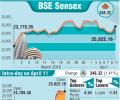
Investors are keenly awaiting the announcement of the macroeconomic data.

Says sugar miscalculation behind 'one-off aberration'; Feb reading weak at 4.1%

The output, as measured by the Index of Industrial Production, had contracted by 2.5 per cent in the same month of last year.

Industrial output maintained its double digit growth for the sixth consecutive month at 13.5 per cent in March, but was lower than expected.

The positive numbers raises hopes of recovery.

Bajaj Finserv was the top loser in the Sensex pack, shedding around 3 per cent, followed by Bajaj Auto, Bajaj Finance, L&T, Asian Paints, Dr Reddy's, ICICI Bank, HDFC Bank and RIL. NSE Nifty finished 101.45 points down at 14,929.50.

Index of Industrial Production is expected to have grown by 1-2 per cent in April, D&B said in a research note, adding that the pace of improvement in consumption and investment demand is likely to take place as per the measures taken by the new government.

Despite near-term headwinds of rising input costs and the possibility of lower demand for products as Covid dented rural & urban India, and impacts both production & consumption, analysts remain bullish on stocks of fast moving consumer goods (FMCG) companies and expect the index to relatively outperform its peers in the second half of fiscal 2021-22 (FY22). In the past one year, prices of key commodities such as groundnut oil, mustard oil, Vanaspati, soya oil, sunflower oil and palm oil have shot up in the range of 20 per cent to 60 per cent, data show. The FMCG sector macros in this backdrop, according to analysts, have further deteriorated because of weakness in consumer demand and likely margin pressure due to elevated crude oil, palm oil and global food prices.
